Sinfonia Viva at the Royal Concert Hall Nottingham Review
16 November 2018
Reviewed by Nigel Chester
Nottingham’s Royal Concert Hall forms half of the Nottingham Theatre Royal and Royal Concert Hall Complex. Built in 1982, the halls acoustics mean it is popular with a wide range of performers and the list of big names to have appeared there is truly impressive.
The evening’s entertainment was a performance of three orchestral works, Serenade for Strings, Op 48 (Tchaikovsky), Violin Concerto, Op 14 (Barber) and Symphony No 41 in C, “Jupiter” (Mozart) brought to us by the well renowned Sinfonia Viva and guest violin soloist Chloe Hanslip.
We were informed at the start of the concert that Conductor Frank Zielhorst had become seriously ill and was unable to appear, with that, the baton was taken up by the talented and versatile conductor Nicholas Kok.
Serenade for Strings, Op 48 (Tchaikovsky)
Under the direction of the Leader of the Orchestra, Ben Holland the first movement was reminiscent of the style of Mozart as the composer intended, with a slow introduction leading to a full development and an athletic exercise for the Cellos, themes building and returning.
The second movement an elegant waltz, complexly crafted but with a light touch.
The third movement is an emotional, robust passage with a definitely darker edge to it.
The final movement, drawn from a collection of Russian folk songs, builds from slow and subdued to lively and energetic, building until the return of the opening notes of the first movement from way before.
Violin Concerto, Op 14 (Barber)
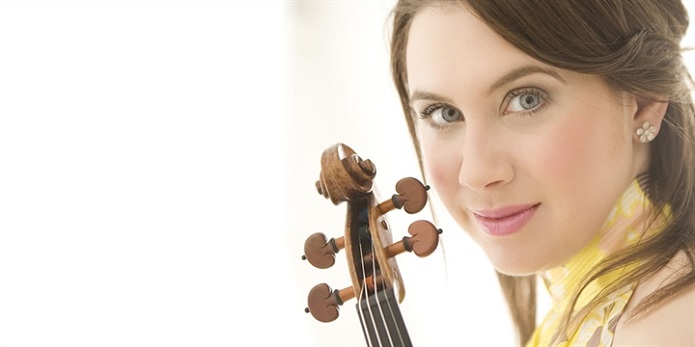
The most popular of Barber’s Concertos, conducted by Nicholas Kok, with guest soloist, the extremely talented and distinguished violinist Chloe Hanslip who used her performance to showcase her ability.
The first movement, a lyrical first theme announced at once by the solo violin, unaccompanied by orchestral introduction.
The second movement, a solo oboe, picked up much later by the violin soloist. Unfortunately, I felt that in the central livelier, more vigorous section, the soloists playing was overpowered by the ensemble.
The final perpetual-motion Presto is a nonstop whirlwind that speeds by in a steady, virtually uninterrupted rhythmic flow, lit by displays of color.
Symphony No 41 in C, “Jupiter” (Mozart)
The first movement, likened to the contrast between dramatic opera and comic-opera Mozart moves the orchestra between the musical styles of his day seamlessly and with ease.
The second movement opens simply with muted strings, building harmonically and rhythmically, the complexities are gone and the movement ends as simply as it began
The third movement, similar in style to a popular Austrian dance form the “Landler”, having a trio section which introduces the four-note figure that forms the main theme of the final movement.
The final movement opens with a progression of the four notes introduced in the previous movement. Four further themes are introduced and there are sections throughout the movement that, either by developing one specific theme, or by combining two or more themes together lead to the culmination of the combination of all five in a dazzling display of the composer’s ingenuity.
A thoroughly enjoyable evening, professional playing.
Rating: 4/5
Sinfonia Viva are currently on your in the UK, for more information and tour dates visit www.vivaorch.co.uk.
For other shows at the Royal Concert Hall in Nottingham visit www.trch.co.uk or call the box office on 0115 989 5555.
Theatre Royal & Royal Concert Hall, Theatre Square, Nottingham, NG1 5ND | 0115 989 5555