
The Nightmare Room at Nottingham Theatre Royal Review
DISCLOSURE – TICKETS TO SEE THE SHOW WERE GIFTED TO THE REVIEWER AND GUEST FOR THE PURPOSES OF WRITING THE REVIEW
Reviewed by Alexander Wilde
Synonymous with summer and a staple of East Midlands theatre, the acclaimed ‘Colin McIntyre Classic Thriller Season’ assuredly returns to Nottingham’s Theatre Royal with three fantastic plays. Second in the line-up is the two-hander ‘The Nightmare Room’, brought to the stage by the talented Tabs Productions team. A spoiler free review of opening night follows.
Based on a short story by Sir Arthur Conan Doyle, ‘The Nightmare Room’ his written by company member John Goodrum and, and, as with all the productions this season, directed by Karen Henson. Once again, the team have served up something surprising and unique, which showcases their range and versatility. August just wouldn’t be the same without experiencing one of their plays and this year the chills are a welcome escape from the heatwave.
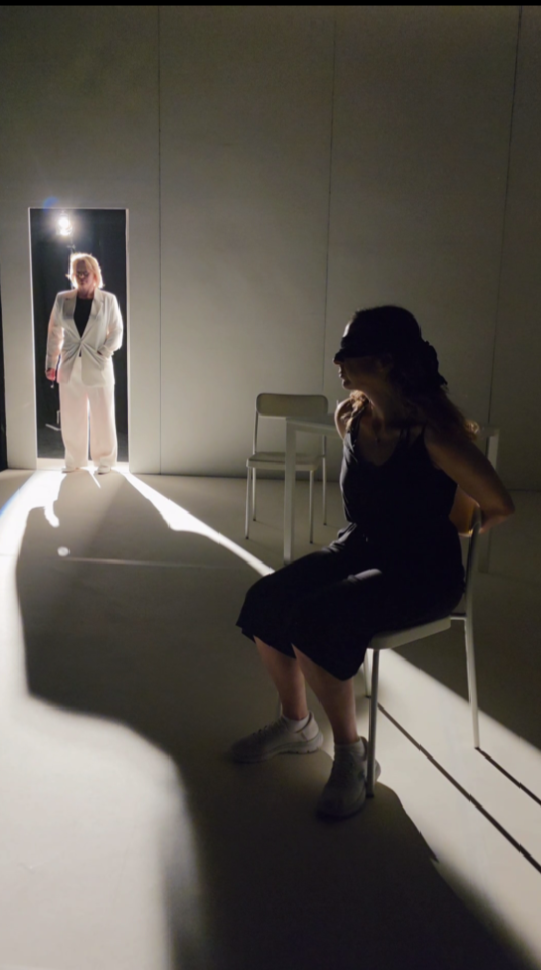
From the moment the curtain rose, we were presented with an atmosphere of stark unease. The set was stripped back: two sides of a bare, tall, white-walled room filled the stage, with a dark floor and darkness above. In the centre sat a small white table and two chairs. Atop the table sat a jug, two glasses and small vial. It was incredibly clinical, sterile and strangely threatening. With so little to scrutinise, the significance of each object was a mystery to being with.
More startling, at the centre of this barren tableau was a woman dressed entirely in contemporary black, blindfolded and bound to one of the chairs. Her captor is another woman, who in contrast, and connected to the room, is dressed predominantly in white. Early questions sprung to mind, what is the significance of these monochrome choices? How does darkness and light play into this story? The audience were drawn to examining this psychological thriller before a single line was spoken.
Performed entirely by stalwarts of stage and screen Sarah Wynne Korda and Corinne Begluk, they carry the weight of this drama with assured confidence and compelling chemistry that comes from passion, talent and dedication to their art and its process. The initial interactions between captor and captive, indicate a significant shared history long before we understand precisely what that history might be. Their relationship, and the events that have brought them to the room, are gradually revealed through cleverly constructed flashbacks, which drop piece after piece of this fractured puzzle in place.
Without venturing into spoiler territory, the captor initially appeared almost unhinged: unquestionably in control of the situation, yet seemingly less certain of herself. There was something beneath the surface that felt unstable, and watching those cracks gradually emerge became one of the production’s most intriguing elements. As the balance of power shifted, we were repeatedly encouraged to reconsider what we thought we knew.
The narrative developed into a high-stakes psychological game centered around infatuation, perception and control. It was a clever device because the real tension lay not simply in what might happen, but in the uncertainty over whom we should believe, or who we should side with.
The technical design was perfect. As there is no elaborate scenery, the production uses sound and lighting to transport us between scenes and timeframes. A harsh, jarring sound cuts through the silence with horror-esque menace, providing an unsettling punctuation between moments. The lighting is equally effective: during the captivity scenes, the harsh white light is unforgiving and reinforces the sense of confinement and the unknown hour. In contrast, the flashbacks are bathed in softer, more subtle lighting, creating an entirely different emotional landscape. These simple distinctions are immensely effective.
In our digital age, where spectacle can sometimes overwhelm the story itself, there is something enthralling about a production that achieves so much with so little. Two talented actors, a stark room, a handful of carefully chosen objects and a story that refuses to reveal all its secrets at once. As this tale twists and turns through trauma, truth, terror and time, ‘The Nightmare Room’ is a perfect example of the purpose and power of theatre.
Whether a long-time fan of the Classic Thriller Season, or looking to try something new, this show is unmissable!
‘The Nightmare Room’ is a delicious psychological drama, which cleverly draws you in to not merely watching the truth emerge, but rather uncovering it; like the characters themselves, we were constantly reassessing, questioning and dissecting what we had been shown. Just when you think you understand the plot, another piece falls into place. And for me, upending the prediction I just whispered in my wife’s ear… Don’t miss out, book today.
Rating: 5/5
Tickets are fantastic value, starting at £19.50.
On Stage from 18-22 August 2026, for more information or to book tickets visit https://www.trch.co.uk/whats-on/classic-thriller-season-the-nightmare-room-y67l
or call the box office on 0115 989 5555
Theatre Royal & Royal Concert Hall, Theatre Square, Nottingham, NG1 5ND
The splendorous, Victorian Theatre Royal, and neighbouring Royal Concert Hall, stand within a clean, well-lit, and popular area of the city centre which has benefited from extensive regeneration and considered transport links. The Theatre is surrounded by a range of bars, restaurants, and entertainment options for a wonderful night out in the bustling city. Arriving by car, routes to the theatre were well signposted and nearby parking was plentiful.
The main foyer is elegant and spacious, with a recently renovated bar. You are sure of a warm greeting and a great atmosphere. The bars/concession stands are well manned, stocked and of standard prices for theatres. I have sat in both stall and dress circle seats; both are comfortable and provide excellent views of the stage.