
SmartGames SnowWhite Deluxe Review

Reviewed by Louise Totton
I am a massive fan of logic puzzles and games, and will quite happily spend an afternoon with a book of the grid style logic puzzles, working out solutions based on processes of elimination and deduction. I have loved these puzzles since I was around 10 or so and I think the critical thinking skills that they encourage and develop are hugely important. With this is mind, I have been looking for games to use with my children to help these skills emerge whilst they are still having fun. I have managed to find plenty for my eight-year-old, but have found that the choice is somewhat more limited for my five-year-old. There seems to be plenty on offer to help develop her number and word skills, but the vast majority of the logic and critical thinking games use thought processes and reasoning that are a little beyond her at the moment.
We were therefore delighted to be asked to try out SmartGames’ newest game, aimed at children aged 4-7. SnowWhite Deluxe is the third puzzle game in a series based on popular fairy tales, with the others being Little Red Riding Hood (aged 4-7) and Three Little Piggies (aged3+).
Contained in the box is a plastic house with colour coded closable shutter windows, a SnowWhite playing piece, 7 colour coded dwarfs (two sets of twins and three singletons), an Evil Queen playing piece, a challenge book containing the puzzles, a Snow White picture book and a set of instructions. On initial inspection, my first impression was that everything in the box was very high quality. The house is substantial, the shutters opened and closed without appearing loose and all the playing pieces are well made and solid.
The house has grooves within the rooms that the playing pieces fit securely into. The pieces click in and do not easily dislodge, meaning no upset kids when they knock the house over mid challenge.
The challenge book contains 48 challenges across 4 levels, ranging from Starter through to Master. Half of these challenges use the interior of the house and half use the exterior. Whilst the book doesn’t contain any text, the illustrations are lovely and they help to provide a context for the game as the house in the illustrations is the same as the plastic house, and the book uses the same coloured dwarves to tell the story as the ones used in the game.
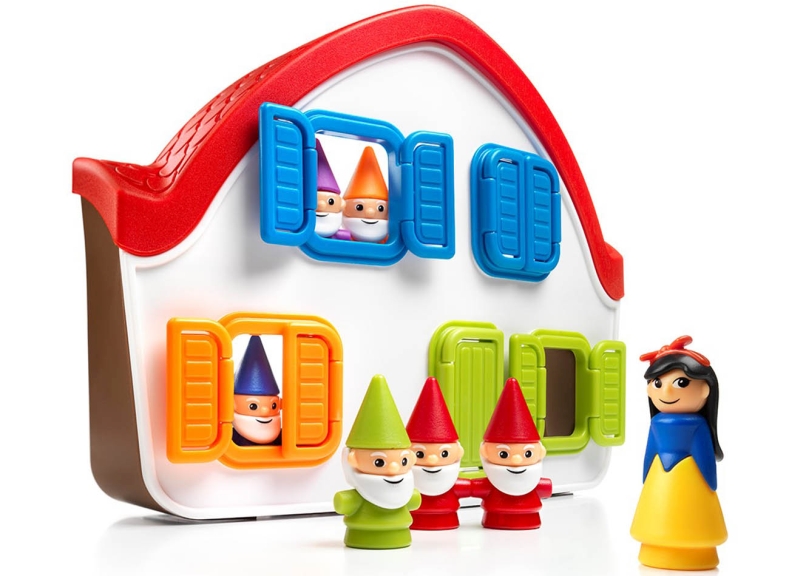
Most board games and logic games are played horizontally; the player looks down onto the board from a ‘bird’s eye’ view. This game is different and is played vertically. The player sits in front of the house with the challenge book and places a small number of characters into the room slots, as indicated in an easy to follow diagram in the challenge book. The idea of the game is then to use logical thinking to work out where the other pieces should be placed. Above each of the challenge diagrams are one or more bits of information (showing what room a particular dwarf does or doesn’t go in / which dwarfs may or may not be in a room together etc.), and this along with the available slots and whether twins or singletons need placing means that there is only one possible solution per challenge. The solution is shown on the back of the page, meaning the child or a parent can easily and quickly check the solution is correct.
I think this game is absolutely fantastic, and more to the point my daughters thought it was great fun. Along with the obvious logical thinking skills that are required, it also provides a fantastic opportunity to develop the language of verbal reasoning. Talking through the games with them provided a fascinating insight into just how well she could reason things out. I also found that the game also really encourages listening skills, as often just careful questioning led my youngest to being able to work the answer out herself.
As I mentioned earlier, half of the challenges use the interior of the house and half use the exterior. The interior challenges mean that all the playing surface can be seen as the inside of the house is orientated towards the player. When playing the exterior challenges, the house is turned the other way and some of the shutters are closed. Whilst I don’t think the exterior challenges were any more technically difficult, they do seem to add an extra dimension as the child also must conceptualise what might be behind a closed door or window.
The packaging says that the game is aimed at children aged 4-7. Whilst a 4-year-old would manage Starter challenges, and probably some of the Junior challenges if playing with an adult, I do think that a child aged 5+ would get more from the game. My 8-year-old daughter also really enjoyed this game too, and whilst I wouldn’t say she found them hugely difficult, some of the harder puzzles were a little challenging for her and she was pleased with herself when she had completed them.
Having now played this game and seeing first-hand how much educational value can be squeezed into such a fun and well-made toy, I will be seeking out other SmartGames for the kids. It is a very simple concept, and as such is quick to learn and the kids are up and running in no time. I think the game has brilliant replay value, as although there are ‘only’ 48 challenges, I don’t think kids of this age would remember the solutions so they will work the answer out each time they play.
All the games in the range are designed to be played solo although they can also be enjoyed with others. They all clearly state the suggested age range and contain multiple levels of challenges, which means that all players would quickly be able to find a level to suit them.
At £19.99, I think this game is fantastic value and is one that I would wholeheartedly recommend to parents with infant school aged children.
Rating: 5/5
RRP: £19.99
For more information or to buy visit www.smartgames.eu.
