
Single White Female At Sheffield Lyceum Review
DISCLOSURE – TICKETS TO SEE THE SHOW WERE GIFTED TO THE REVIEWER AND GUEST FOR THE PURPOSES OF WRITING THE REVIEW
Reviewed by Latesha Brown
Single White Female arrives onstage with the legacy of its 1992 film predecessor, a psychological thriller that framed closeness as danger and trust as something easily undone. Yet, as I walked out of the theatre, I felt slightly underwhelmed. I had that familiar post-show buzz of questions circling in my mind, but not in the satisfying, provocative way a psychological thriller should provoke. Instead, it felt as though the emotional payoff didn’t fully match the carefully built tension. Adapted for the stage by Rebecca Reid, this production focuses less on shock value and more on the psychological undercurrent. At its centre lies a question about identity, belonging, and the fragile line between connection and control. In an era shaped by social media, curated identities, and heightened visibility, that question feels less sensational and more unsettlingly familiar.
Reid’s adaptation is clearly rooted in the 90s cult classic, with its DNA remaining visible throughout. The essential narrative remains: female friendship turning obsessive, blurred identities, and boundaries crossed. The tension between vulnerability and control still drives the story, but this version leans into a distinctly modern twist. Where the original film thrived on erotic-thriller energy and claustrophobic apartment suspense, the stage adaptation, though set from start to finish within a modern London high-rise, shifts its focus to contemporary pressures such as cyberbullying, co-parenting struggles, financial strain, and the complexities of blended families in a digital age. This relevance is one of the production’s strengths. But in softening some of the film’s darker, more psychologically unsettling edges, the stage version never quite reaches the same level of intensity. It certainly resonates, although it just doesn’t entirely creep under the skin.
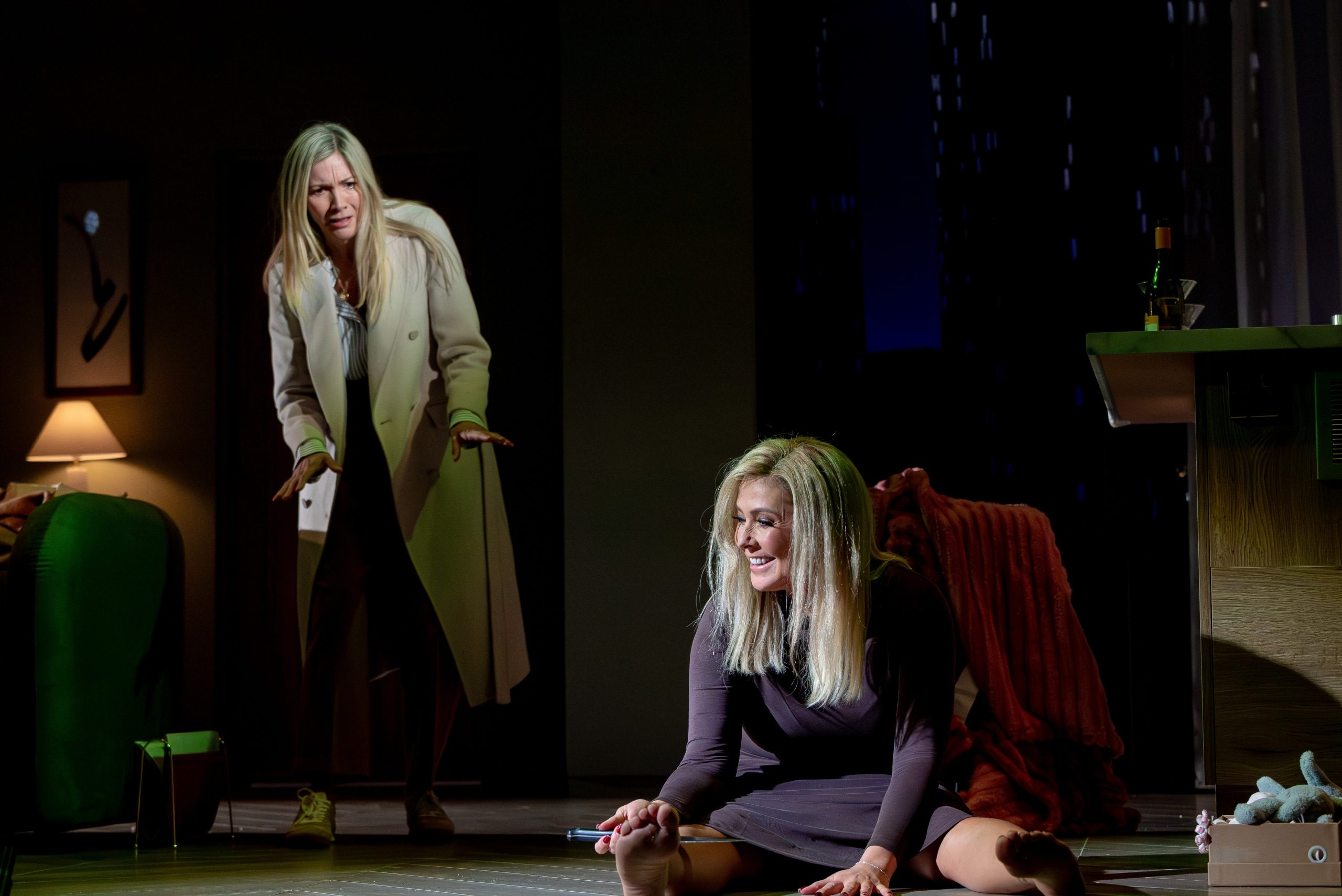
The production includes a cast of familiar faces. Kym Marsh, as Hedy, brings a familiarity that makes the character’s psychological complexity even more intriguing, and Lisa Faulkner’s return to the stage after two decades positions her as Allie- the emotional anchor of the narrative and a character who must navigate the uneasy balance between capability and vulnerability, between independence and the desire for support. Performance-wise, Marsh carried the show. Her portrayal of Hedy was a slow burn in the most effective sense. She revealed layers gradually, offering glimpses of vulnerability before allowing instability to surface. There was a notable restraint in her choices and watching her grow close with Bella was one of the production’s strongest elements. That gradual intimacy- at times almost maternal, at others quietly possessive- generated genuine tension. Marsh understood pacing, using silence and stillness to her advantage; her experience was unmistakable in those quieter, unsettling moments.
Amy Snudden, as Bella, delivered a standout performance. She offered a believable, relatable portrayal of a modern teenager navigating cyberbullying and the relentless pressure to fit in, capturing moody, frightened and angry beats with striking authenticity. Her vulnerability grounded the narrative in something recognisably contemporary, which in turn strengthened the adaptation’s modern relevance. The dynamic between her and Marsh added real nuance to the story; their shared scenes were the most immersive of the evening.
By contrast, Lisa Faulkner’s performance as a struggling newly single mother felt less convincing. The emotional framework was there, but it was harder to fully connect with her portrayal. I found myself wanting more of Allie’s desperation and inner conflict, particularly given how crucial she is in propelling the story forward. The supporting cast helped sustain momentum. Andro (as Graham) and Jonny McGarrity (as Sam) shape the social framework around the central relationship, providing the external perspectives that determine how far boundaries can be stretched. Particularly, McGarrity’s presence further stabilised the narrative rhythm, ensuring that even when emotional stakes felt uneven, the story continued to move with structure and intention. All the cast delivered on the promise of dark humour, which helped to balance out the tension, although I couldn’t help but notice the audience nervously laughed a lot more during the second act, which at times felt a little uncomfortable given that this was during some of the most dramatic scenes.
From a design perspective, the lighting was particularly effective. The interplay between coloured lighting, strip lights, and contrasts of brightness and shadow built the atmosphere well and added a layer of thriller aesthetic that the script sometimes lacked. It created visual suspense and helped transitions flow smoothly. The sound design was less consistent. From the stalls, some dialogue felt too quiet, which broke the sense of immersion, especially for a psychological thriller that relies on subtle detail.
The Lyceum itself is a comfortable and accessible venue, and it continues to offer an experience that feels welcoming from the moment you arrive. The front-of-house areas are easy to navigate, and staff manage the flow of people smoothly, which helps avoid that familiar pre-show congestion. The bar was straightforward to access and service was efficient, meaning there was time to enjoy refreshments if you wished without feeling rushed. The interval was well timed, giving the audience enough space to reset without losing momentum. Inside the auditorium, the traditional layout preserves the theatre’s classic charm. It is worth noting, however, that seat choice can make a noticeable difference so I would recommend slightly higher for clearer sound and better visibility.
One of the clearest modern shifts in this adaptation is its focus on the digital age and the power, and danger, of social media. The messaging around being careful about what you share digitally is explicit and timely. There is also a literal looming presence hanging above the stage for much of the production, which creates an underlying sinister energy that keeps you intrigued, even in quieter moments. Combined with the effective use of lighting and music to build suspense, the atmosphere had real potential to reach something chilling. However, the production overall blends domestic drama with psychological thriller, so fans of character-driven tension and contemporary domestic thrillers will find much to enjoy.
Rating: 3/5
Tickets range from £15 to £53.50.
Single White Female is on at the Lyceum Theatre, Sheffield from Tuesday 24 – Saturday 28 February 2026, before transferring to the New Victoria Theatre, Woking from 3 – 7 March 2026.
For more information or to book tickets at the Lyceum Theatre Sheffield, visit: https://www.sheffieldtheatres.co.uk/events/single-white-female?
or call the Box Office on: 0114 249 6000