
The Woman In Black At Theatre Royal Nottingham Review
DISCLOSURE – TICKETS TO SEE THE SHOW WERE GIFTED TO THE REVIEWER AND GUEST FOR THE PURPOSES OF WRITING THE REVIEW
Reviewed by Sheridan Brown
I’m always open to a new experience. So, when I was invited, with my partner, to be part of the audience for the opening night of ‘The Woman in Black’ at Theatre Royal, Nottingham, I put aside my misgivings around the horror genre – and decided to take the plunge!
I’d heard that The Woman in Black is an amazing piece of theatre. It’s been described as ‘a brilliantly successful study in atmosphere, illusion and controlled horror’. Adapted by the late Stephen Mallatratt, and based on Susan Hill’s unsettling ghost story, the play is one of the most successful and long-running theatre shows of the West End. As a bit of a scaredy-cat – I was just hoping I hadn’t bitten off more than I could chew!
Using the format of a ‘play-within-a-play’ the production tells the story of London solicitor, Arthur Kipps. Many years earlier, Kipps had been sent to the remote, decaying Eel Marsh House, in order to tie up the estate of its former owner, Mrs Drablow. After a series of terrifying events, Kipps believes he and his family have been cursed by a mysterious spectre – a Woman in Black. Kipps is convinced that telling his story will exorcise the curse and employs a young, enthusiastic actor to help him tell his story. But will facing his fears help him to lay to rest the terror that consumes him?
We travelled by tram into Nottingham city centre; a very easy 25-minute journey from Clifton South park and ride. We got off the tram at Royal Centre, which is adjacent to the Theatre Royal. As always we were warmly greeted by staff; they are always so welcoming and helpful; nothing is too much trouble. The theatre is well laid out and it was easy to find our door and seat. Accessibility at the theatre is excellent with a lift to all floors.
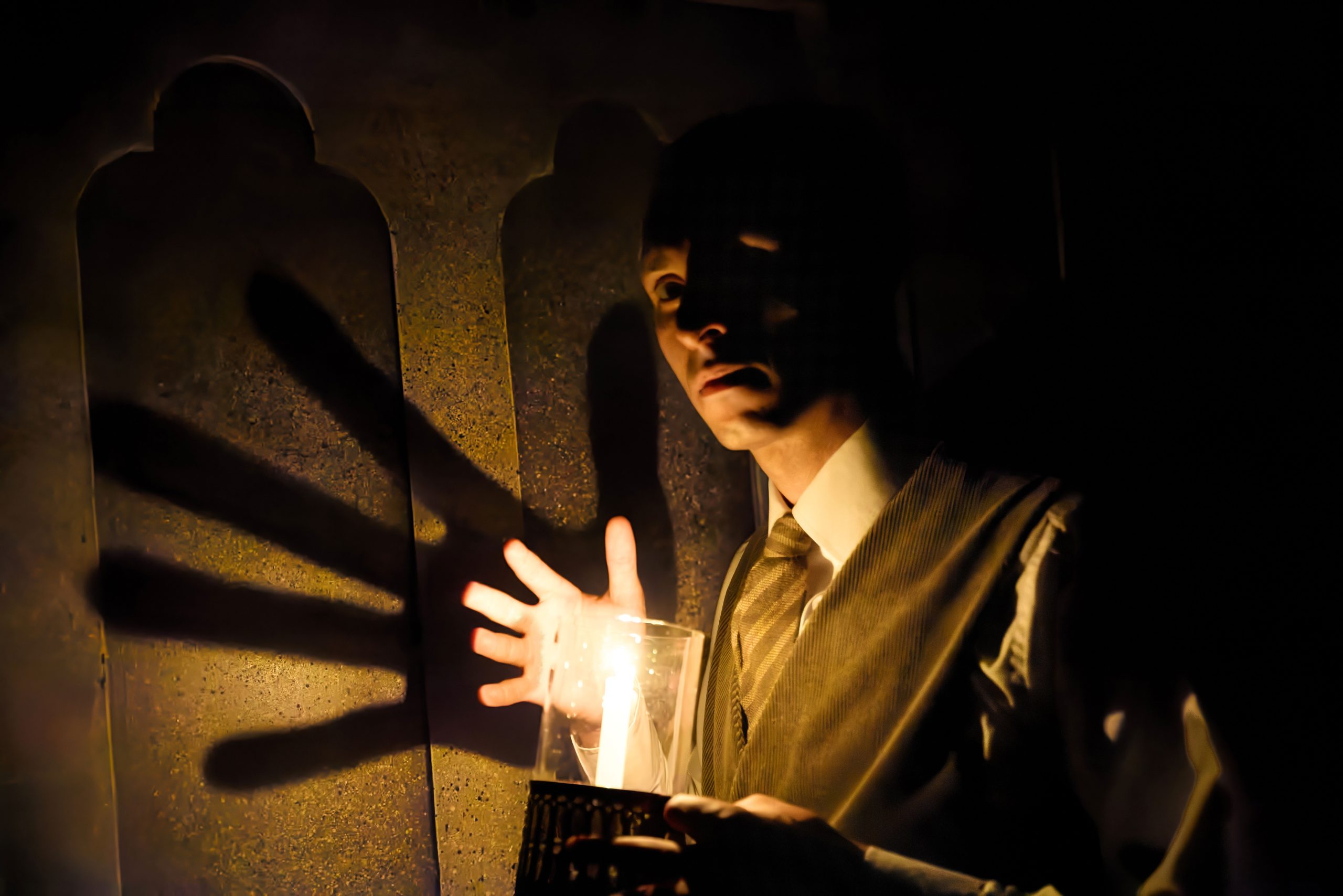
As we settled in our seats we took in the stage. Depicting a theatrical space, the set was minimalist in design. A chair, a large laundry hamper, and lots of dingy dust sheets, hanging ceiling to floor. Designed by Michael Holt – the simplicity of the set and props is at the heart of the play. Rather than an elaborate set and special effects, the play relies on story-telling, suggestion and the audiences’ imagination to conjure up genuine suspense and controlled fear.
The play opens with Arthur Kipps (brilliantly played by John Mackay) trying to recount a story from his past – reading from a large folio of notes. He is not a natural actor, and struggles to bring his account to life. Enter The Actor (played superbly by Daniel Burke) who has been employed to help Kipps do just that. The first awkward false starts of Kipps trying to act are hilarious. The skills demonstrated by Mackay are amazing. Playing a non-actor, trying to be a good actor can’t be easy – but Mackay did it with superb dexterity.
As the play-within-a-play moves forward, The Actor takes on young Kipps’ role – and Kipps plays all other significant parts in the story. We were blown away by the versatility of John Mackay here. Using simple costume changes and prop-use he created a tapestry of rich and believable characters who played supporting roles in the telling of Kipps’ story. Wonderful versatility was shown by Mackay, in the way he sometimes flipped from one character to another. We are familiar with the idea of an actor leaving the stage and maybe re-entering as another character – but Mackay was able to do this brilliantly – mid-scene, in a finger-click. Gradually, the awkwardness and humour of the opening ‘scenes’ give way to a vivid and expertly-played rendering of Kipps’ dark story. And soon, the story-telling blurs into real-time lived experience of a haunting. The audience can’t help but be gripped.
By no means is Daniel Burke left in Mackay’s shadow. Burke’s characterisations of The Actor and young Kipps were nuanced and convincing. His performance was full of emotion and depth of character. We could see The Actor had been deeply changed by re-living Kipps’ story. The Actor/Kipps’ chemistry with the audience drove the narrative forward, and compelled us to live his trauma with him.
Directed by Robin Herford, it is not only the minimalist staging and structure that make this play so effective. The movement of the actors around the stage, the use of the drapes, Sebastian Frost’s fantastic use of sound – and silence – serve to contribute to a mounting sense of dread. The production cleverly builds suspense, allowing the atmosphere to grow darker and more menacing as the play progresses. There are a few jump-scare moments – but these are carefully controlled to keep the audience on their toes – and filled with dread-anticipation.
We were both particularly impressed by the quality of lighting design in the play. Kevin Sleep, the Lighting Designer, has done an amazing job – not only helping the audience to locate different scenes in the play, but in creating atmosphere and tension throughout. The timing of lighting effects was done with pin-point precision and could not be faulted. Superb!
So, had I bitten off more than I could chew? Not at all. The age guidance of 12+ should have been a clue. But having said that, the play was very suspenseful and scary. The horror was generated by my own imagination and investment in the story – cleverly honed by the production as a whole. The play was a reminder that sometimes, the scariest things are those that are left unseen – lurking just beyond the edges of the stage.
Rating: 5/5
Dates: Tues 10th March – Saturday 14th March
Tickets: £19 – £43
Age guidance: 12+
Remaining shows are bookable here: https://trch.co.uk/whats-on/the-woman-in-black-5q6n